The Congressional Evolution of the United States of America: The Presidential Series


Introduction:
In most history textbooks, compilers do enumerate the differences between the current executive office of U.S. President and Commander-in-Chief with the presidential office that once presided over the Continental and Articles of Confederation Congresses. The opinion, however, that these “Presidents of Congress” were actually United States “Heads of State” is not addressed in American history texts. Moreover, the examination of the similarities and differences between the Continental Congress, United States in Congress Assembled and the current United States Congress is also deficient of thoughtful studentship.
The Congressional Evolution of the United States of America (CEUS) curriculum has been specifically designed to address these and key 1774-1790 political incongruities, which ultimately gave rise to the Congressional call for “…a Convention of delegates … to be held at Philadelphia for the sole and express purpose of revising the Articles of Confederation ...” The curriculum also addresses the Delegates decision to scrap the Articles of Confederation, frame the current United States Constitution and Congress proposing, on September 25, 1789, twelve constitutional amendments for States’ ratification consideration.
The CEUS Curriculum was developed on the datum that there were three different congresses that preceded the current United States House of Representatives and Senate in Congress Assembled:
- United Colonies of North America Continental Congress (UCCC)
- United States of America Continental Congress (USCC)
- United States of America in Congress Assembled (USCA)
The examination of the United States under the lens of its Congressional progression provides students with a pedagogy that can help them understand numerous founding inconsistencies like United States officials heralding the nation’s birthdate as July 4, 1776, while the United States Mint produces Delaware “First State” quarters based the State’s 1787 ratification of the current United States Constitution. Were there not member states in the United States of America Republic between 1776 and 1787?
The CEUS curriculum addresses this contradiction in its module titled: Debate: Which State is the first U.S. State? Here, students are provided with primary sources demonstrating that New Hampshire’s United Colonies Continental Congress Delegates were the first to vote for Independence on July 2, 1776, while Virginia was the “First State” to ratify the Articles of Confederation on December 16, 1777,” and Delaware was the “First State” to ratify the current U.S. Constitution on December 7, 1787. Students are then asked:
- Was Delaware the First State? If not which State do you think is the first U.S. State?
- What historical evidence can be used to support your position?
- Work with your classmates to come to a consensus on which State was the “First U.S. State.”
In addition to releasing the Congressional Evolution of the United States curriculum, we are in the process of creating 20 new CEUS Presidential Series videos for www.uspresidency.com. Four of the videos, First UCCC President Peyton Randolph, Second UCCC President Henry Middleton, Third USCA President John Hanson and Fifth USCA President Thomas Mifflin are completed and posted on this website.
Finally, many of our former visitors may be wondering what happened to the America’s Four Republics concept unveiled at the Annapolis Continental Congress Festival in 2012. No reservations, the scholarship is sound but the pedagogy was too controversial for the primary and secondary educational systems in the United States. The Congressional Evolution of the United States Curriculum does address the possibility of different U.S. republics in its second module Challenge: Did the United Colonies Continental Congress govern as a Republic?, which provides ample primary sources for students to arrive at their own conclusions.
As always comments are welcomed, especially from students. They can be submitted by email to: stan@johnhancock.org.
Stanley Yavneh Klos
June 1, 2018
Chart Comparing Presidential PowersStudents and Teachers of US History this is a video of Stanley and Christopher Klos presenting America's Four United Republics Curriculum at the University of Pennsylvania's Wharton School. The December 2015 video was an impromptu capture by a member of the audience of Penn students, professors and guests that numbered about 200.
of America's Four United Republics - Click Here
To understand the differences
between these presidencies, we turn to the
book, The Congressional Evolution of the United States of America that organizes the U.S. Congresses into their four
different categories.

The United Colonies Continental Congress (UCCC) was formed by 12
colonies on September 5th, 1774, and expired on July 1st, 1776, with
the Resolution for Independency’s passage on July 2nd, 1776. The United Colonies Continental Congress provided for the security of its member Colonies with the formation
of a Continental Army, the creation of a post office, the election of foreign
ministers, and the issuing of its own currency. Peyton Randolph and
George Washington served, respectively, as the first United Colonies
Continental Congress President and Commander-in-Chief;
The United Colonies Continental Congress Presidents
Sept. 5, 1774 to July 1, 1776
September 5, 1774
|
October 21, 1774
| |
October 22, 1774
|
October 26, 1774
| |
May 20, 1775
|
May 24, 1775
| |
May 25, 1775
|
July 1, 1776
|
Commander-in-Chief United Colonies of America
George Washington: June 15, 1775 - July 1, 1776
 |
National Collegiate Honor’s Council Partners in the Park Class of 2017 students at Carpenters' Hall with the docent holding a Virginia Three Pound Note signed by the first President of the United Colonies Continental Congress Peyton Randolph AND a 1776 Autograph Letter Signed by Cyrus Griffin the last President of the United States in Congress Assembled. Carly is holding an original 1774 printing of the Articles of Association passed in this hall, which named the Continental Congress and the Address to the King's Most Excellent Majesty by the Continental Congress dated October 1774 and signed, Henry Middleton, President – For more information visit our National Park and NCHC Partners in the Park Class of 2017 website |
The United States Continental Congress (USCC) was formed by 12 colonies with the passage of the Resolution for Independency on July 2nd, 1776 and expired on February 28th, 1781, with the Articles of Confederation’s enactment on March 1st, 1781. There was no constitution and the republic was governed under the acts passed by the Continental Congress with each State having one vote in quorums as small as seven member States. Only one delegate was required to have a State’s vote tallied in Congress. John Hancock and George Washington served, respectively, as the republic's first United States Continental Congress President and Commander-in-Chief;
The United States Continental Congress Presidents
July 2, 1776 to February 28, 1781
July 2, 1776
|
October 29, 1777
| |
November 1, 1777
|
December 9, 1778
| |
December 10, 1778
|
September 28, 1779
| |
September 29, 1779
|
February 28, 1781
|
Commander-in-Chief United States of America
George Washington: July 2, 1776 - February 28, 1781
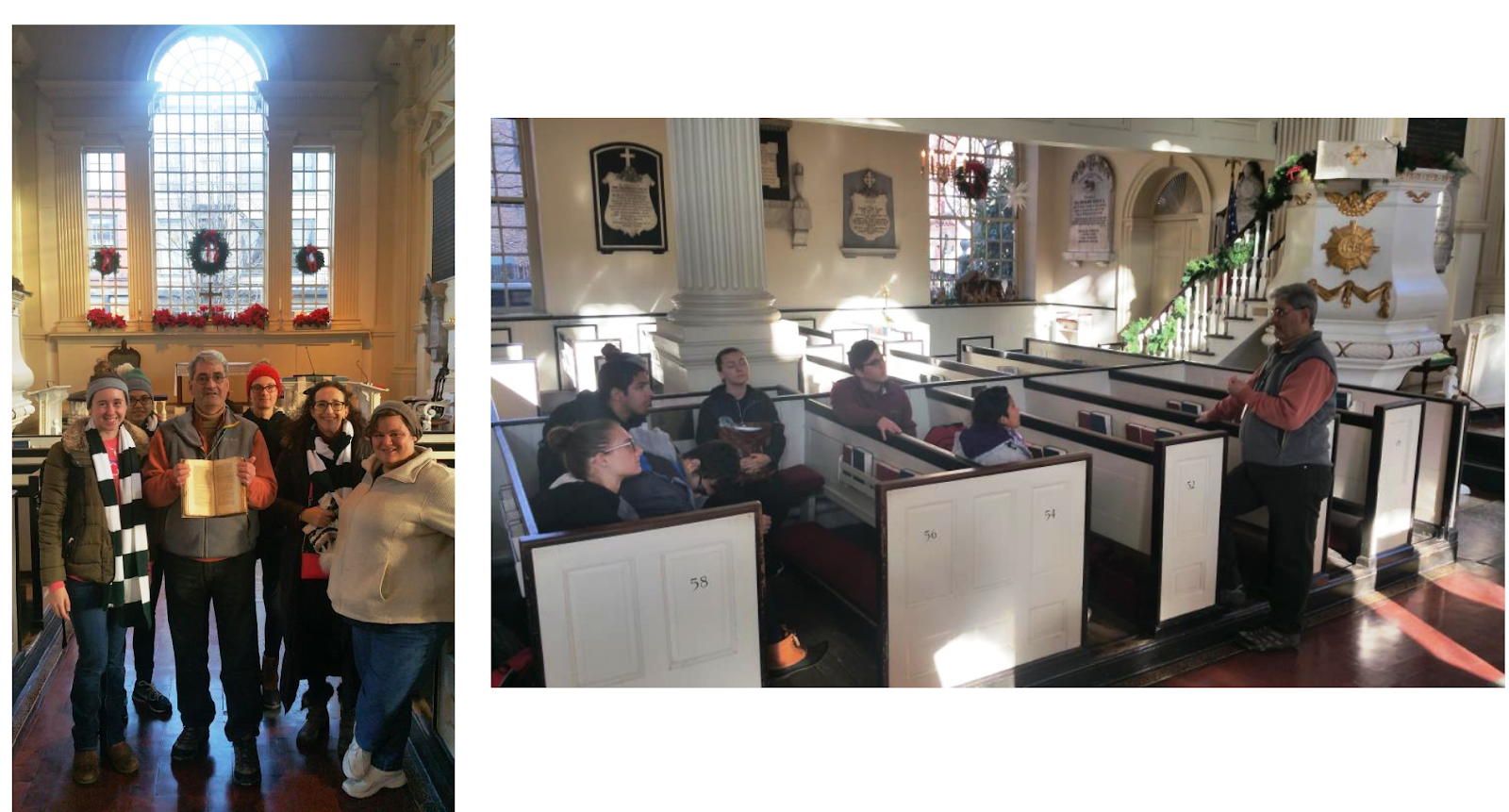 |
Neil Ronk, Senior Guide and Historian of the Christ Church Preservation Trust holds up John Dunlap's 1777 York-Town printing of the 1776 Journals of Congress flanked by NCHC Honors Students. The Journals have been opened to July 2nd 1776, marking the passage of the Resolution for Independency. - For more information visit our National Park and NCHC Partners in the Park Class of 2017 website |
The United States in
Congress Assembled (USCA) was
formed by 13 States with the Articles of Confederation’s enactment on March 1st,
1781, and expired on March 3rd,
1789, with the implementation of the current
U.S. Constitution on March 4th, 1789. The republic was constitutionally
governed under Articles of Confederation with state quorums on important
matters requiring nine members with a two delegate minimum present in Congress
per State. All constitutional changes
required the unanimous approval of the 13 member States. Samuel Huntington and
George Washington served, respectively, as the republic's first United States
in Congress Assembled President and Commander-in-Chief;
The United States in Congress Assembled Presidents
March 1, 1781 to March 3, 1789
March 1, 1781 to March 3, 1789
March 1, 1781
|
July 6, 1781
| |
July 9, 1781
|
Declined Office
| |
July 10, 1781
|
November 4, 1781
| |
November 5, 1781
|
November 3, 1782
| |
November 4, 1782
|
November 2, 1783
| |
November 3, 1783
|
June 3, 1784
| |
November 30, 1784
|
November 22, 1785
| |
November 23, 1785
|
June 5, 1786
| |
June 6, 1786
|
February 1, 1787
| |
February 2, 1787
|
January 21, 1788
| |
January 22, 1788
|
January 21, 1789
|
Commander-in-Chief United States of America
United States in Congress Assembled Sessions
Articles of Confederation Constitution
USCA
|
Session Dates
|
Convene Date
|
President(s)
|
First
|
11-05-1780 to 11-04-1781*
|
03-02-1781
|
Samuel Huntington & Thomas McKean
|
Second
|
11-05-1781 to 11-03-1782
|
11-05-1781
|
|
Third
|
11-04-1782 to 11-02-1783
|
11-04-1782
|
|
Fourth
|
11-03-1783 to 10-31-1784
|
11-03-1783
|
|
Fifth
|
11-01-1784 to 11-06-1785
|
11-29-1784
|
|
Sixth
|
11-07-1785 to 11-05-1786
|
11-23-1785
|
John Hancock & Nathaniel Gorham
|
Seventh
|
11-06-1786 to 11-04-1787
|
02-02-1787
|
|
Eighth
|
11-05-1787 to 11-02-1788
|
01-21-1788
|
|
Ninth
|
11-03-1788 to 03-03-1789**
|
None
|
None
|
* The Articles of Confederation was ratified by the mandated 13th State on February 2, 1781, and the dated adopted by the Continental Congress to commence the new United States in Congress Assembled government was March 1, 1781. The USCA convened under the Articles of Confederation Constitution on March 2, 1781.
** On September 14, 1788, the Eighth United States in Congress Assembled resolved that March 4th, 1789, would be commencement date of the Constitution of 1787's federal government thus dissolving the USCA on March 3rd, 1789.
On February 22, 1781, it was unanimously resolved by Congress that:
The delegates of Maryland having taken their seats in Congress with powers to sign the Articles of Confederation: Ordered, That Thursday next [March 1, 1781] be assigned for compleating the Confederation; and that a committee of three be appointed, to consider and report a mode for announcing the same to the public: the members, [Mr. George] Walton, Mr. [James] Madison, Mr. [John] Mathews.

|
| 18th Century Journals of U.S. CONTINENTAL CONGRESS and USCA Congress for 1781 showing votes to adopt the 13 States ratification of the Articles of Confederation. No matter how many delegates a state had they had only one vote. – Klos Yavneh Collection |
The March 1st, 1781, enacted
Constitution of 1777 provided for a unicameral
governing body called the United States in Congress Assembled
(USCA) to govern the United States of America. The USCA
was charged " .. to appoint one of their members to
preside, provided that no person be allowed to serve in the
office of president more than one year in any term of three
years."
On March 2nd, 1781, the
Delegates, who were duly elected after each State had
ratified the Articles of Confederation, convened in
Philadelphia as the United States in Congress
Assembled with
Samuel Huntington presiding as the first USCA President.
Additionally, George Washington
continued to serve as General and Commander-in-Chief of the
United States Continental Army.

|
| Journals of the United States in Congress Assembled, March 2, 1781 entry recording "His excellency Samuel Huntington, delegate for Connecticut, President." |
The Constitution
of 1777 Presidency, although similar to its
predecessor, was a different and weaker office
then that of the U.S. Continental Congress
Presidency.
For instance, the
Continental Congress Presidents, who served from
September 5, 1774 to February 28, 1781, presided over a
government that could enact legislation binding all 13
States with only a seven state quorum as opposed to the
nine state minimum required by the Constitution of
1777. Additionally, Continental Congress Presidents,
who decided what legislation came before Congress, often
found themselves as the sole vote for their state,
giving them a 1/7th to 1/13th vote over crucial
legislation, appointments, judicial decisions, and even
military orders enacted during the Revolutionary War.
After March 1, 1781, the Constitution of
1777 mandated that two or more delegates must be
present from each state for that delegation to be marked
present and be eligible to vote in the new USCA
government. Therefore, on March 2nd, 1781,
the first act of the USCA was to disqualify both New
Hampshire and Rhode Island from voting in the new
assembly because they each had only one delegate
present.
On May 4,
1781, to
further weaken presidential powers, Congress passed
the "Rules for conducting business in the United
States in Congress assembled." that stripped
the President of his power to control the congressional
agenda which, was a tactic that the presiding officers
(especially Henry Laurens)
had expertly wielded as Continental
Congress Presidents. These new USCA rules even
went so far as to eliminate the President's prerogative
to continue the debate, before a second to the motion was
brought to the floor.
Rule 10. When a motion is made and seconded it shall be repeated by the President or If he or any other member desire being in writing it shall be delivered to the President in writing and read aloud at the table before it, shall be debated.
There are numerous other examples
on the differences between the two offices that range
from the USCA's Committee of the
States experiment to govern the USA by
a "Board of Directors" without
the USCA President at its head
to John Hanson's success
in championing the congressional resolution that
moved the bulk of his presidential correspondence
duties to USCA Secretary Charles
Thomson.
Moreover, USCA Foreign Secretaries Robert R.
Livingston and John
Jay took
over most of the U.S. Presidential duties of
entertaining foreign diplomats and dignitaries under
the Articles of Confederation
government.
Finally, the President of the
United States in Congress Assembled, the the
Presidents of the Continental Congress would receive
only a Delegate Salary from their home States.
The only compensation the President would
receive was for his household expenses as evidenced
below:

|
1785 Broadside of the "Estimate of the Annual Expenditure of the Civil Departments of the United States, on the present Establishment" indicating the expenditure for President Richard Henry Lee's household was $11,203.13. The President was paid no salary for that office but did received a salary from his home State at the same rate of his fellow Virginia Delegates.  
|
1785 Broadside of the "Estimate of the Annual Expenditure of the Civil Departments of the United States, on the present Establishment" - It is important to note that no paper Continental dollars were issued after 1779, and they had stopped circulating as money by 1781. In 1785, the United States in Congress Assembled made the dollar the official unit of account of the U.S. government, but did not issue physical dollar currency, thus by "dollars" they meant the Spanish milled dollar. No one denominated any transactions in Continental paper dollars after 1781. Now, banknotes denominated in dollar units (again meaning Spanish milled dollars) were being used from 1781 on (Bank of North America, several state banks, and then the First Bank of the US), but these notes were not official legal tender currency before Alexander Hamilton, as Secretary of the Treasury, simply declared paper banknote dollars of several banks as good as Spanish milled dollars for paying Federal taxes.It would not be until 1792 that the US Mint struck its own silver dollar at a slightly different value (weight) then Spanish milled dollar. Spanish milled dollars, along with many other foreign specie coins, remained a legal tender in the United States until 1854. - Email Excerpt paraphrased from Dr. Farley Grubb, Economics Professor, University of Delaware.

"General George Washington Resigning His Commission" by John Trumbull (1756–1843) - Circa 1817 and placed in the United States Capitol rotunda in Washington D.C. in 1824. Its dimensions are 144" in × 216" inches. General George Washington resigned his commission as Commander-in-Chief of the Army to the Congress, which was then meeting at the Maryland State House in Annapolis, on December 23, 1783. This action was of great significance in establishing civilian, rather than military rule, leading to a republic, rather than a dictatorship. Washington stands with two aides-de-camp addressing the President of the United States in Congress Assembled, Thomas Mifflin, Elbridge Gerry, Thomas Jefferson, James Monroe, James Madison, Thomas Stone,William Ellery, Roger Sherman and other delegates.
George
Washington continued to serve as General and
Commander-in-Chief of the United States Continental
Army until December 23, 1783. On that date, in
Annapolis, Maryland, Washington submitted his
resignation to President Thomas Mifflin during
a regular session of the United States in Congress
Assembled. The USCA would not appoint
another Commander-in-Chief in its
remaining five years as the unicameral federal
government of the United States.
Presidential
Alert: After 102 Years, The
Federal Government Finally Agrees: Samuel
Huntington And Not John
Hanson Was The First USCA President to
Serve Under The Articles of Confederation.
-- Click
Here
On September 13th the
Delegates “finally passed, without a
dissentient voice or the least apparent
animosity,” a federal capital location and
the USCA enacted this enabling
resolution:
… whereas the constitution so reported by the Convention and by Congress transmitted to the several legislatures has been ratified in the manner therein declared to be sufficient for the establishment of the same and such ratifications duly authenticated have been received by Congress and are filed in the Office of the Secretary therefore Resolved That the first Wednesday in January next be the day for appointing Electors in the several states, which before the said day shall have ratified the said constitution; that the first Wednesday in February next be the day for the electors to assemble in their respective states and vote for a president; and that the first Wednesday in March next be the time and the present seat of Congress the place for commencing proceedings under the said constitution.[1]
Virginia delegate Henry Lee delivered the news on the
13th to George
Washington noting that the capital would
remain in New York and added this paragraph on the
new U.S. Presidency:
It would certainly be unpleasant to you & obnoxious to all who feel for your just fame, to see you at the head of a tumbling system. It is a sacrifice on your part, unjustifiable in any point of view. But on the other hand no alternative seems to be present. Without you the govt. can have but little chance of success, & the people of that happiness, which its prosperity must yield.[2]
The USCA continued to try and form a quorum after
Griffin's Presidential term expired as evidenced by
Tench Coxe letter to James Madison on January 27th,
1789:
"I have been here about a Fortnight during which time we have not made a Congress. So. Carolina, Virga, Pennsa, N. Jersey, & Massachussets are represented. There is one Member from each of the States of Rhode Island, N. Carolina & Georgia, but none from New Hampshire, Connecticut, N. York, Delaware or Maryland. I very much wish we may make a house in a week or ten days, as I think the Appearance in Europe, & perhaps even here, of the old Congress being in full operation and tranquilly yielding the seats to the new would have a good effect. The misrepresentations in Europe have been extremely gross, and must have an unfavorable effect upon Emigration in the poorer ranks of life. Col. Wadsworth has been mentiond as President. I respect him much, but I wish to give appearance to the old System by a Character of rather more celebrity. Mr. Adams would meet my Judgment better than any member of the present house. The principal Objection is his Absence, which I fear will deprive him of his chance."
A quorum never formed and the
Articles of Confederation Presidency ended with Cyrus
Griffin on January 21, 1789. From January 22, 1789,
until George Washington took office under the
Constitution of 1787 on April 30th, 1789,
there was no one serving as "President" in
the United States of American
Republic.
The last
entry in USCA Journals is dated, March 2, 1789 and
records Mr Philip Pell, the Delegate from New York,
attending the last quorum call. On March 3rd,
1789, the unicameral government known as the United
States in Congress Assembled simply faded away with
only North Carolina and Rhode Island still ascribing
to the defunct "Perpetual Union."

|
Articles of Confederation and Constitution of
1787 language establishing its respective
offices of President.
|
 |
National Collegiate Honor’s Council Partners in the Park Class of 2017 Students at the 2nd Bank of the United States under the portrait of USCA President Samuel Huntington. Sydney is holding-up a Revolutionary War–dated manuscript document signed as President of the Continental Congress, “Sam. Huntington,” May 16, 1780. This is a $6,000 pay order issued to Joseph Borden, commissioner of the Continental Loan Office of New Jersey for clothing. Chris is holding-up a document signed by James Lawrence, and cancelled by Oliver Ellsworth, Jr. for monies owed by the State of Connecticut to Huntington for his service as a delegate to congress and the nation. The note is dated March 11, 1781, which was the 11th day of the Huntington’s service as the first USCA President under the Articles of Confederation. On the verso is of this document is written "Number 1424 Certificate, Saml Huntington Dat 1 Feby, 1781, £ 11-9-4" with a second signature “Saml Huntington.” President Samuel Huntington was the first President to serve under the Articles of Confederation, not John Hanson. – For more information visit our National Park and NCHC Partners in the Park Class of 2017 website |

The United States House of
Representatives (HR) and Senate in Congress
Assembled were formed
by 11 states with the United States
Constitution of 1787’s enactment on March 4th, 1789. The republic is currently governed under this United States Constitution and its 27
Amendments. Frederick
Muhlenberg served as the first Speaker of the House, Vice President John Adams
served as the first President of the Senate, John Jay served as the first Chief
Justice, and George Washington served as the first U.S. President and Commander-in-Chief
of the United States of America (POTUS).
This Fourth American Congress was established by the United States Constitution of 1787 and commenced, as resolved by an act of the USCA, on March 4th, 1789. The Constitution of 1787, unlike the Constitution of 1777, only required the ratification of nine states to adopt a new government for the United States of America. By August 1788 all thirteen states had held ratifying conventions and only two, North Carolina and Rhode Island, failed to adopt the Constitution of 1787. On September 13th, 1788 the USCA Delegates agreed on a federal capital location, without a dissentient voice or the least apparent animosity, and this was the last obstacle in finalizing the plan to launch the current federal republic. The USCA, on the same day, enacted this enabling resolution:
… whereas the constitution so reported by the Convention and by Congress transmitted to the several legislatures has been ratified in the manner therein declared to be sufficient for the establishment of the same and such ratifications duly authenticated have been received by Congress and are filed in the Office of the Secretary therefore Resolved That the first Wednesday in January next be the day for appointing Electors in the several states, which before the said day shall have ratified the said constitution; that the first Wednesday in February next be the day for the electors to assemble in their respective states and vote for a president; and that the first Wednesday in March next be the time and the present seat of Congress the place for commencing proceedings under the said constitution.

|
US Constitution of 1787, United States in Congress Assembled Enabling Resolution Broadside date September 13th, 1788, and signed by USCA Secretary Charles Thomson. |
Tuesday, March 3rd, 1789,
was established as the last day the USCA would govern the
United States of America.
On Wednesday, March 4th, 1789, neither the United States House of Representatives or the Senate was able to achieve their constitutionally mandated quorums. The March 4, 1789 Journal of the House of Representatives reports:
NEW HAMPSHIRE, MASSACHUSETTS, CONNECTICUT, NEW YORK, NEW JERSEY, PENNSYLVANIA, DELAWARE, MARYLAND,
VIRGINIA, SOUTH CAROLINA, and GEORGIA:
Being the eleven States have respectively ratified the Constitution of Government of the United States, proposed by the Federal Convention, held in Philadelphia, on the 17th of September, 1787.
Congress of the United States, begun and held at the city of New York, on Wednesday, the fourth of March, one thousand seven hundred and eighty-nine, pursuant to a resolution of the late Congress, made in conformity to the resolutions of the Federal Convention of the 17th September, 1787; being the first session of the Congress held under the Constitution aforesaid. On which day, the following members of the House of Representatives appeared and took their seats, to wit:
From Massachusetts,George Thatcher,Fisher Ames,George Leonard, andElbridge Gerry.From Connecticut,Benjamin Huntington,Jonathan Trumbull, andJeremiah Wadsworth.From Pennsylvania,Frederick Augustus Muhlenberg,Thomas Hartley,Peter Muhlenberg, andDaniel Heister.From Virginia, ... Alexander White.From South Carolina, ... Thomas Tudor Tucker.
But a quorum of the whole number not being present, the House adjourned until to-morrow morning eleven o'clock.On April 1st, 1789, the United States House of Representatives achieved its first quorum. On April 6th, 1789, the United States Senate achieved its first quorum and elected its officers. On April 21st, 1789 John Adams took the oath of Vice President and presided as United States Senate President.

|
George Washington's April 30th, 1789, inauguration oil painting, Circa 1899 by Ramon de Elorriaga |
On April 30th,
1789, George Washington
was inaugurated at
Federal Hall as the first President and
Commander-in-Chief of the United States of
America.
Broadside
Announcing Ceremonial for Washington's Inauguration, 29
April 1789
THE
Committees of both Houses of Congress, appointed to take
order for conducting the ceremonial of the formal
reception, &c. of the President of the United Stares,
on Thursday next, have agreed to the following order
thereon, viz.
That
General Webb, Colonel Smith, Lieutenant-Colonel Fish,
Lieut. Col. Franks, Major L'Enfant, Major Bleecker, and Mr.
John R. Livingston, be requested to serve as Assistants on
the occasion.
That
a chair he placed in the Senate-Chamber for the President
of the United States. That a chair be placed in the
Senate-Chamber for the Vice-President, to the right of the
President’s chair; and that the Senators take their seats
on that side of the chamber on which the Vice-President’s
chair shall be placed. That a chair be placed in the
Senate-Chamber for the Speaker of the House of
Representatives, to the left of the President’s chair—and
that the Representatives take their seats on that side of
the chamber on which the Speaker’s chair shall be
placed.
That
seats be provided in the Senate-Chamber sufficient to
accommodate the late President of the United
States in Congress Assembled [Cyrus Griffin of
Virginia], the Governor of the Western
territory [Arthur St Clair], the five persons being the
heads of the three great departments [Secretary of Foreign
Affairs John Jay, Secretary of War Henry Knox,
Commissioners of the Treasury Arthur Lee, Walter
Livingston, and Samuel Osgood], the Minister
Plenipotentiary of France [Eleanor Francois Elie, Cpmte de
Moustier], the Encargado de negocios of Spain [Don Diego de
Gardoqui], the Chaplains of Congress [Bishop Samuel
Provoost. Dr. William Liin], the persons in the suite of
the President:42 and also to accommodate
the following Public Officers of the State, viz. The
Governor [George Clinton], the Lieutenant-Governor [Pierre
Van Cortlandt], the Chancellor [Robert R. Livingston], the
Chief Justice [Richard Morris], and other Judges of the
Supreme Court [Robert Yates, Jon Sloss Hobart], and the
Mayor of the city [James Duane]. That one of the Assistants
wait on these gentlemen, and inform them that seats are
provided for their accommodation, and also to signify to
them that no precedence of seats is intended, and that no
salutation is expected from them on their entrance into, or
their departure from the Senate-Chamber.
That
the members of both Houses assemble in their respective
Chambers precisely at twelve o’clock, and that the
Representatives preceded by the Speaker, and attended by
their Clerk, and other Officers proceed to the
Senate-Chamber, there to be received by the Vice-President
and Senators rising.
That
the Committees attend the President from his residence to
the Senate-Chamber, and that he be there received by the
Vice-President, the Senators and Representatives rising,
and be by the Vice-President conducted to his
chair.
That
after the President shall be seated in his Chair and the
Vice-President, Senators and Representatives shall be again
seated, the Vice-President shall announce to the President
that the members of both Houses will attend him to be
present at his taking the Oath of Office required by the
Constitution. To the end that the Oath of Office may be
administered to the President in the most public manner,
and that the greatest number of the people
of the United States and without
distinction, may be witnesses to the solemnity, that
therefore the Oath be administered in the outer Gallery
adjoining to the Senate Chamber.
That
when the President shall proceed to the gallery to take the
Oath, he be attended by the Vice-President, and be followed
by the Chancellor of the State, and pass through the door
on the right, and the Representatives, preceded by the
Speaker, pass through the door on the left, and such of the
persons who shall have been admitted into the
Senate-Chamber, and may be desirous to go into the gallery,
are then also to pass through the door on the right. That
when the President shall have taken the Oath, and returned
into the Senate-Chamber, attended by the Vice-President,
and shall be seated in his chair, that the Senators and the
Representatives also return into the Senate-Chamber, and
that the Vice-President and they resume their respective
seats.
Both
Houses having resolved to accompany the President after he
shall have taken the Oath, to St. Paul’s Chapel, to hear
divine service, to be performed by the Chaplain of
Congress, that the following order of procession be
observed, viz. The door-keeper [Gifford Dalley] and
messenger [‘Ihomas Claxton] of the House of
Representatives. The Clerk of the House [John Beckley]. The
Representatives. The Speaker. The President, with the
Vice-President at his left hand. The Senators. The
Secretary of the Senate [Samuel A. Otis]. The door-keeper
[James Mathews] and messenger [Cornelius Maxwell]
of the Senate.
That
a Pew be reserved for the President—Vice-President—Speaker
of the House of Representatives, and the Committees; and
that pews be also reserved sufficient for the reception of
the Senators and Representatives.
That
after divine service shall be performed, the President be
received at the door of the Church, by the Committees, and
by them attended in carriages to his
residence.
That it be intrusted to the Assistants to take proper
precautions for keeping the avenues to the Hall open, and
that for that purpose, they wait on his Excellency the
Governor of this State, and in the name of the Committees
request his aid, by an order or recommendation to the Civil
Officers, or militia of the city, to attend and serve on
the occasion, as he shall judge most
proper.


On September 24th, 1789, the United States Congress set the yearly salary of the United States President at $25,000 and the Vice President at $5,000. The 1789 Presidential salary of $25,000 translates to $672,000 in 2012 dollars. Currently the US Presidential salary is $400,000/year, plus a $50,000 non-taxable expense account. The compensation of the President is controlled by law, Compensation of the President: Title 3, Section 102.
The Supreme Court was first called to assemble on On February 1, 1790, in the Merchants Exchange Building in New York City. The first Supreme Court was made up of Chief Justice, John Jay, from New York and Associate Justices:
John Rutledge, from South Carolina;William Cushing, from Massachusetts;James Wilson, from Pennsylvania;John Blair, from Virginia.

|
| The
current President and Commander-in-Chief of
the United States of America Honorable Barack H. Obama |
 |
National Collegiate Honor’s Council Partners in the Park Class of 2017 students at Federal Hall National Historic Park with Ranger holding the 1789 Acts of Congress opened to the 12 Amendment Joint Resolution of Congress issued September 25th, 1789. The only amendment in the "Bill of Rights" that was not ratified is Article the First, which is still pending before Congress. Cintly is holding an Arthur St. Clair signed Northwest Territory document, Imani is holding the First Bicameral Congressional Act establishing the U.S. Department of State and Rachael is holding a 1788 John Jay letter sent to the Governor of Connecticut, Samuel Huntington, transmitting a treaty with France. – For more information visit our National Park and NCHC Partners in the Park Class of 2017 website |
Presidents of the United States of America
D-Democratic Party, F-Federalist Party, I-Independent, R-Republican Party, R* Republican Party of Jefferson & W-Whig Party
(1789-1797)
|
(1933-1945)
| |
(1865-1869)
| ||
(1797-1801)
|
(1945-1953)
| |
(1869-1877)
| ||
(1801-1809)
|
(1953-1961)
| |
(1877-1881)
| ||
(1809-1817)
|
(1961-1963)
| |
(1881 - 1881)
| ||
(1817-1825)
|
(1963-1969)
| |
(1881-1885)
| ||
(1825-1829)
|
(1969-1974)
| |
(1885-1889)
| ||
(1829-1837)
|
(1973-1974)
| |
(1889-1893)
| ||
(1837-1841)
|
(1977-1981)
| |
(1893-1897)
| ||
(1841-1841)
|
(1981-1989)
| |
(1897-1901)
| ||
(1841-1845)
|
(1989-1993)
| |
(1901-1909)
| ||
(1845-1849)
|
(1993-2001)
| |
(1909-1913)
| ||
(1849-1850)
|
(2001-2009)
| |
(1913-1921)
| ||
(1850-1853)
|
(2009-2017)
| |
(1921-1923)
| ||
(1853-1857)
|
(20017-Present)
| |
(1923-1929)
|
*Confederate States of America
| |
(1857-1861)
| ||
(1929-1933)
| ||
(1861-1865)
|
Current Order of Presidential Succession
The Vice President
Speaker of the House
President pro tempore of the Senate
Secretary of State
Secretary of the Treasury
Secretary of Defense
Attorney General
Secretary of the Interior
Secretary of Agriculture
Secretary of Commerce
Secretary of Labor
Secretary of Health and Human Services
Secretary of Housing and Urban Development
Secretary of Transportation
Secretary of Energy
Secretary of Education
Secretary of Veterans Affairs
Chart Comparing Presidential Powers - Click Here
United Colonies and States First Ladies
The Vice President
Speaker of the House
President pro tempore of the Senate
Secretary of State
Secretary of the Treasury
Secretary of Defense
Attorney General
Secretary of the Interior
Secretary of Agriculture
Secretary of Commerce
Secretary of Labor
Secretary of Health and Human Services
Secretary of Housing and Urban Development
Secretary of Transportation
Secretary of Energy
Secretary of Education
Secretary of Veterans Affairs
Chart Comparing Presidential Powers - Click Here
United Colonies and States First Ladies
1774-1788
United Colonies Continental Congress
|
President
|
18th Century Term
|
Age
|
Elizabeth "Betty" Harrison Randolph (1745-1783)
|
09/05/74 – 10/22/74
|
29
| |
Mary Williams Middleton (1741- 1761) Deceased
|
Henry Middleton
|
10/22–26/74
|
n/a
|
Elizabeth "Betty" Harrison Randolph (1745–1783)
|
05/20/ 75 - 05/24/75
|
30
| |
Dorothy Quincy Hancock Scott (1747-1830)
|
05/25/75 – 07/01/76
|
28
| |
United States Continental Congress
|
President
|
Term
|
Age
|
Dorothy Quincy Hancock Scott (1747-1830)
|
07/02/76 – 10/29/77
|
29
| |
Eleanor Ball Laurens (1731- 1770) Deceased
|
Henry Laurens
|
11/01/77 – 12/09/78
|
n/a
|
Sarah Livingston Jay (1756-1802)
|
12/ 10/78 – 09/28/78
|
21
| |
Martha Huntington (1738/39–1794)
|
09/29/79 – 02/28/81
|
41
| |
United States in Congress Assembled
|
President
|
Term
|
Age
|
Martha Huntington (1738/39–1794)
|
03/01/81 – 07/06/81
|
42
| |
Sarah Armitage McKean (1756-1820)
|
07/10/81 – 11/04/81
|
25
| |
Jane Contee Hanson (1726-1812)
|
11/05/81 - 11/03/82
|
55
| |
Hannah Stockton Boudinot (1736-1808)
|
11/03/82 - 11/02/83
|
46
| |
Sarah Morris Mifflin (1747-1790)
|
11/03/83 - 11/02/84
|
36
| |
Anne Gaskins Pinkard Lee (1738-1796)
|
11/20/84 - 11/19/85
|
46
| |
Dorothy Quincy Hancock Scott (1747-1830)
|
11/23/85 – 06/06/86
|
38
| |
Rebecca Call Gorham (1744-1812)
|
06/06/86 - 02/01/87
|
42
| |
Phoebe Bayard St. Clair (1743-1818)
|
02/02/87 - 01/21/88
|
43
| |
Christina Stuart Griffin (1751-1807)
|
01/22/88 - 01/29/89
|
36
|
Constitution of 1787
First Ladies |
President
|
Term
|
Age
|
April 30, 1789 – March 4, 1797
|
57
| ||
March 4, 1797 – March 4, 1801
|
52
| ||
Martha Wayles Jefferson Deceased
|
September 6, 1782 (Aged 33)
|
n/a
| |
March 4, 1809 – March 4, 1817
|
40
| ||
March 4, 1817 – March 4, 1825
|
48
| ||
March 4, 1825 – March 4, 1829
|
50
| ||
December 22, 1828 (aged 61)
|
n/a
| ||
February 5, 1819 (aged 35)
|
n/a
| ||
March 4, 1841 – April 4, 1841
|
65
| ||
April 4, 1841 – September 10, 1842
|
50
| ||
June 26, 1844 – March 4, 1845
|
23
| ||
March 4, 1845 – March 4, 1849
|
41
| ||
March 4, 1849 – July 9, 1850
|
60
| ||
July 9, 1850 – March 4, 1853
|
52
| ||
March 4, 1853 – March 4, 1857
|
46
| ||
n/a
|
n/a
| ||
March 4, 1861 – April 15, 1865
|
42
| ||
February 22, 1862 – May 10, 1865
| |||
April 15, 1865 – March 4, 1869
|
54
| ||
March 4, 1869 – March 4, 1877
|
43
| ||
March 4, 1877 – March 4, 1881
|
45
| ||
March 4, 1881 – September 19, 1881
|
48
| ||
January 12, 1880 (Aged 43)
|
n/a
| ||
June 2, 1886 – March 4, 1889
|
21
| ||
March 4, 1889 – October 25, 1892
|
56
| ||
June 2, 1886 – March 4, 1889
|
28
| ||
March 4, 1897 – September 14, 1901
|
49
| ||
September 14, 1901 – March 4, 1909
|
40
| ||
March 4, 1909 – March 4, 1913
|
47
| ||
March 4, 1913 – August 6, 1914
|
52
| ||
December 18, 1915 – March 4, 1921
|
43
| ||
March 4, 1921 – August 2, 1923
|
60
| ||
August 2, 1923 – March 4, 1929
|
44
| ||
March 4, 1929 – March 4, 1933
|
54
| ||
March 4, 1933 – April 12, 1945
|
48
| ||
April 12, 1945 – January 20, 1953
|
60
| ||
January 20, 1953 – January 20, 1961
|
56
| ||
January 20, 1961 – November 22, 1963
|
31
| ||
November 22, 1963 – January 20, 1969
|
50
| ||
January 20, 1969 – August 9, 1974
|
56
| ||
August 9, 1974 – January 20, 1977
|
56
| ||
January 20, 1977 – January 20, 1981
|
49
| ||
January 20, 1981 – January 20, 1989
|
59
| ||
January 20, 1989 – January 20, 1993
|
63
| ||
January 20, 1993 – January 20, 2001
|
45
| ||
January 20, 2001 – January 20, 2009
|
54
| ||
January 20, 2009 to January 20, 2016
|
45
|
January 20, 2016 – Present
|
Capitals of the United Colonies and States of America
Philadelphia
|
Sept. 5, 1774 to Oct. 24, 1774
| |
Philadelphia
|
May 10, 1775 to Dec. 12, 1776
| |
Baltimore
|
Dec. 20, 1776 to Feb. 27, 1777
| |
Philadelphia
|
March 4, 1777 to Sept. 18, 1777
| |
Lancaster
|
September 27, 1777
| |
York
|
Sept. 30, 1777 to June 27, 1778
| |
Philadelphia
|
July 2, 1778 to June 21, 1783
| |
Princeton
|
June 30, 1783 to Nov. 4, 1783
| |
Annapolis
|
Nov. 26, 1783 to Aug. 19, 1784
| |
Trenton
|
Nov. 1, 1784 to Dec. 24, 1784
| |
New York City
|
Jan. 11, 1785 to Nov. 13, 1788
| |
New York City
|
October 6, 1788 to March 3,1789
| |
New York City
|
March 3,1789 to August 12, 1790
| |
Philadelphia
|
Dec. 6,1790 to May 14, 1800
| |
Washington DC
|
November 17,1800 to Present
|

Book a primary source exhibit and a professional speaker for your next event by contacting Historic.us today. Our Clients include many Fortune 500 companies, associations, non-profits, colleges, universities, national conventions, PR and advertising agencies. As a leading national exhibitor of primary sources, many of our clients have benefited from our historic displays that are designed to entertain and educate your target audience. Contact us to learn how you can join our "roster" of satisfied clientele today!
Hosted by The New Orleans Jazz Museum and The Louisiana Historical Center
Historic.us
A Non-profit Corporation
Primary Source Exhibits
727-771-1776 | Exhibit Inquiries
202-239-1774 | Office
202-239-0037 | FAX
Dr. Naomi and Stanley Yavneh Klos, Principals
Naomi@Historic.us
Stan@Historic.us
Primary Source exhibits are available for display in your community. The costs range from $1,000 to $35,000 depending on length of time on loan and the rarity of artifacts chosen.
Website: www.Historic.us
 |
| U.S. Dollar Presidential Coin Mr. Klos vs Secretary Paulson - Click Here |
The United Colonies of North America Continental Congress Presidents (1774-1776)
The United States of America Continental Congress Presidents (1776-1781)
The United States of America in Congress Assembled Presidents (1781-1789)
The United States of America Presidents and Commanders-in-Chiefs (1789-Present)
